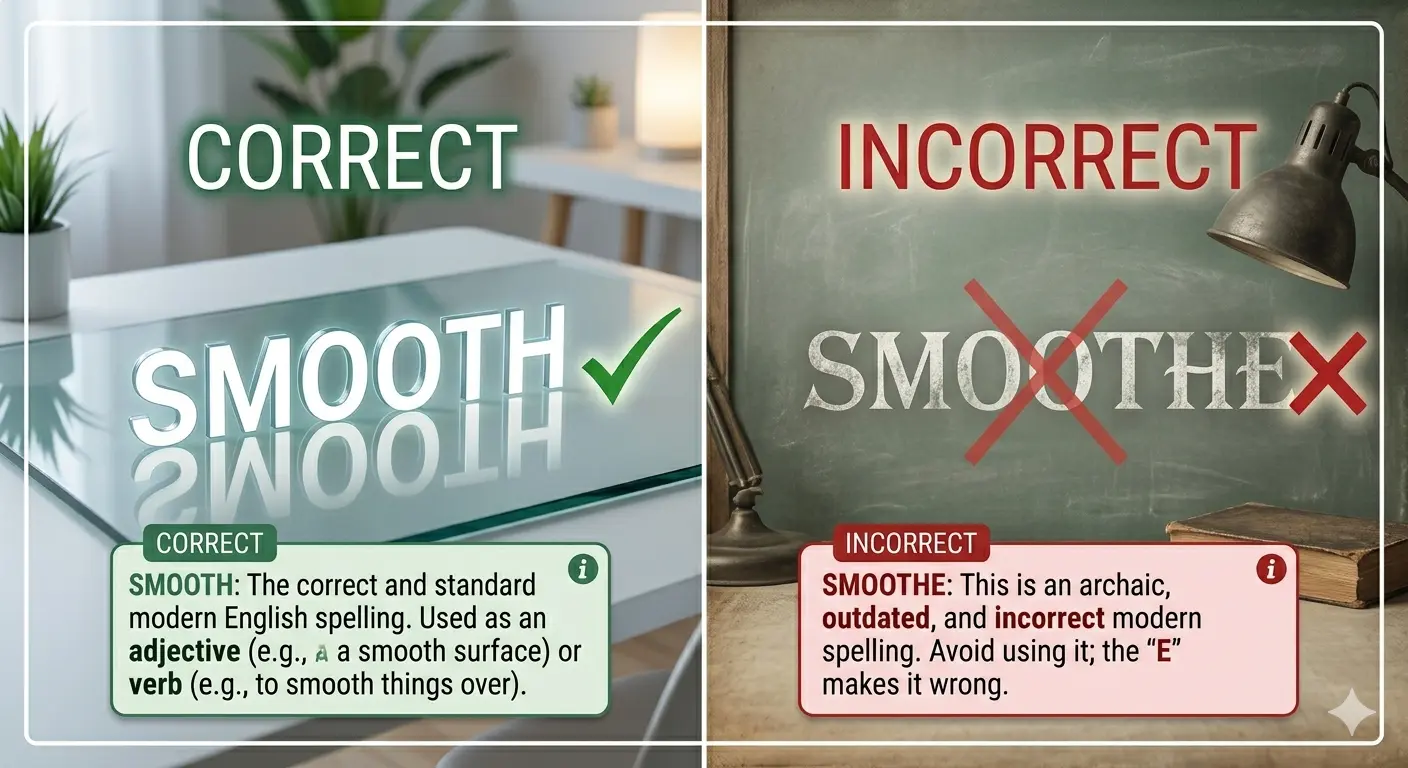
The confusion between smooth or smoothe is a common spelling question for English learners, writers, and even native speakers. People often search this keyword when they are unsure whether the correct spelling includes an “e” at the end or not.
This doubt usually appears while writing emails, essays, product descriptions, or social media posts where correctness matters. The smooth or smoothe confusion mainly comes from older English spelling patterns and modern simplified spelling rules. In today’s digital writing world, even a small spelling mistake can affect clarity and professionalism.
Many learners wonder if both forms are acceptable or if one is completely wrong. The truth is that English spelling has evolved over time, and some words lost their extra letters. The smooth or smoothe debate helps us understand how English changed from historical to modern usage.
In this article, we will clearly break down the correct form, its origin, usage differences, and real-life examples so you never get confused again when writing.
Smooth or Smoothe – Quick Answer
The correct modern spelling is “smooth.”
“Smoothe” is an old or incorrect spelling and is not used in modern English.
Examples:
- Correct: The table is very smooth.
- Incorrect: The table is very smoothe.
- Correct: Her skin feels smooth.
- Incorrect: Her skin feels smoothe.
Shiney or Shiny: Which Spelling Is Correct?
The Origin of Smooth or Smoothe
The word smooth comes from Old English smōth, meaning soft, flat, or even in texture. Over time, English spelling was simplified.
The spelling “smoothe” appeared in older English texts but gradually disappeared as language rules became standardized. English dropped many silent or extra letters to improve simplicity and consistency.
Today, “smooth” is the only accepted form in modern dictionaries.
British English vs American English Spelling
Interestingly, smooth is spelled the same in both British and American English. There is no difference in modern usage.
However, older British texts sometimes used “smoothe,” which is now outdated.
Comparison Table
| Feature | British English | American English |
| Correct spelling | smooth | smooth |
| Old spelling | smoothe (archaic) | smoothe (archaic) |
| Modern usage | smooth only | smooth only |
Which Spelling Should You Use?
If you are writing for any audience—US, UK, Canada, or global English—you should always use “smooth.”
- For academic writing → smooth
- For business emails → smooth
- For SEO content → smooth
- For social media → smooth
The spelling “smoothe” should be avoided completely unless you are analyzing historical texts.
Roll Call or Role Call: Which One Is Correct?
Common Mistakes with Smooth or Smoothe
Many learners make these mistakes:
- Adding extra “e” → smoothe ❌
- Confusing adjective and verb usage
- Thinking British English uses “smoothe”
Corrections:
- Wrong: The surface is smoothe
- Right: The surface is smooth
- Wrong: Please smoothe the paper
- Right: Please smooth the paper
Smooth or Smoothe in Everyday Examples
Emails:
- “Please ensure the document has a smooth flow.”
News Writing:
- “The athlete made a smooth recovery after injury.”
Social Media:
- “This skincare product gives smooth skin!”
Formal Writing:
- “The process was smooth and efficient throughout.”
Smooth or Smoothe – Google Trends & Usage Data
Google search trends show that “smooth” is overwhelmingly dominant worldwide.
- USA: 99% smooth usage
- UK: 99% smooth usage
- India & Pakistan: mostly smooth, learning confusion exists
- “Smoothe” appears very rarely and mostly in spelling mistakes or historical references
This shows that modern English has fully standardized the spelling.
Comparison Table: Smooth vs Smoothe
| Feature | Smooth | Smoothe |
| Status | Correct | Incorrect/archaic |
| Usage | Modern English | Old English texts |
| Dictionary listing | Yes | No |
| Professional use | Recommended | Not recommended |
| SEO usage | High ranking | No ranking value |
FAQs about Smooth or Smoothe
1. Is “smoothe” correct English?
No, it is outdated and not used in modern English.
2. What is the correct spelling?
The correct spelling is smooth.
3. Why do people write “smoothe”?
It comes from old English spelling habits and confusion.
4. Is “smooth” used in both US and UK English?
Yes, both use the same spelling.
5. Can I use “smoothe” in writing?
No, it is not accepted in formal or modern writing.
6. Does “smooth” have different meanings?
Yes, it can describe texture, movement, or behavior.
7. Is “smooth” a verb or adjective?
It can be both depending on sentence use.
Conclusion
The confusion between smooth or smoothe is common, but the answer is simple: “smooth” is the only correct modern spelling. The form “smoothe” is outdated and no longer used in standard English. Understanding this difference helps improve writing accuracy, especially in professional, academic, and online content.
English spelling has evolved to become simpler, and “smooth” is part of that modernization. Whether you are writing emails, articles, or social media posts, always choose “smooth” to maintain clarity and correctness.
Avoiding outdated forms like “smoothe” ensures your writing looks professional and trustworthy. By learning small differences like this, you can significantly improve your English communication skills and avoid common spelling mistakes in the future.

I am Bahadar Ali, a professional content writer and the author behind Tensestutor.com I am passionate about making grammar simple and accessible for everyone. Through my writing, I aim to help learners and professionals communicate with clarity and confidence.