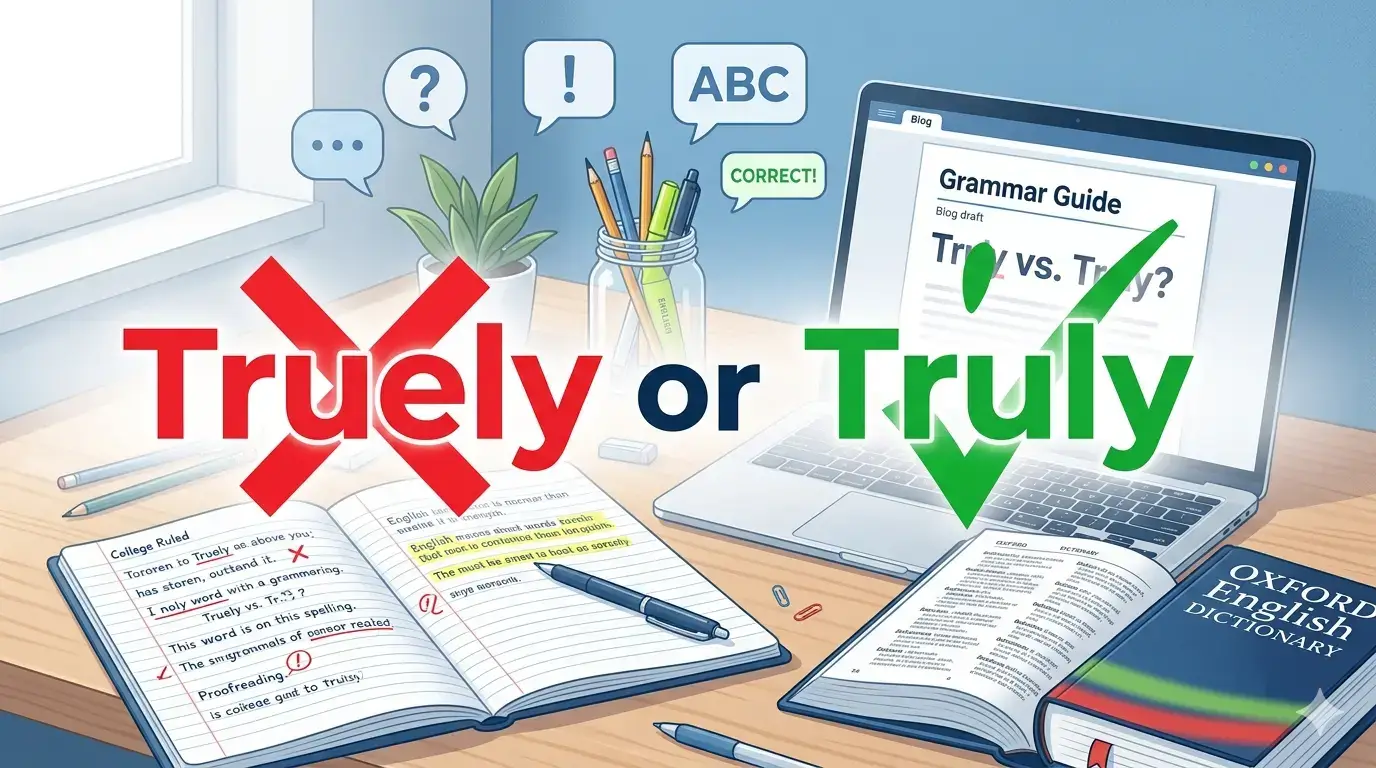
Have you ever typed the word truely and seen a red spelling line appear? Many people stop and wonder: is it truely or truly? The two words look very similar, which makes the confusion common in emails, school writing, social media posts, and business documents.
The correct spelling is truly. The spelling truely is considered incorrect in standard English. Still, many people search for this keyword because the word “true” keeps its “e” in many other forms like “trueful” or “trueness.” That makes learners think “truely” should also be correct.
English spelling rules can sometimes feel confusing, especially with adverbs. In this guide, you will learn the correct spelling, the history of the word, British and American English usage, common mistakes, and real-life examples. You will also see why “truly” became the accepted spelling worldwide.
If you want clear grammar advice and easy examples, this article will help you use the right spelling with confidence.
Truely or Truly – Quick Answer
The correct spelling is truly.
❌ Truely
✅ Truly
The word truly means:
- honestly
- sincerely
- really
- genuinely
Examples
- I truly appreciate your help.
- She is truly happy today.
- This story is truly inspiring.
The spelling truely is a common mistake and should be avoided in formal writing.
Onsite or On-Site: Which Spelling Is Correct?
The Origin of Truely or Truly
The word truly comes from the adjective true.
In Old English, many adverbs were formed by adding -ly to adjectives. Normally, people expect:
- true + ly = truely
But English removes the silent “e” before adding -ly in some words.
Examples:
| Base Word | Correct Adverb |
| True | Truly |
| Due | Duly |
| Whole | Wholly |
This spelling pattern developed over time and became standard in modern English dictionaries.
That is why truly is correct even though it may look unusual at first.
Shiney or Shiny: Which Spelling Is Correct?
British English vs American English Spelling
Unlike many English words, there is no major difference here between British and American English.
Both forms of English use:
✅ Truly
❌ Truely
Comparison Table
| Version | Correct Spelling | Incorrect Spelling |
| British English | Truly | Truely |
| American English | Truly | Truely |
| Australian English | Truly | Truely |
| Canadian English | Truly | Truely |
No major English style guide accepts “truely” as standard spelling.
Which Spelling Should You Use?
You should always use truly in:
- blogs
- emails
- school writing
- business communication
- academic work
- social media captions
- professional documents
Best Choice for Global Readers
✅ Truly
This spelling is accepted worldwide and appears in dictionaries, grammar books, and official writing.
Example Sentences
- I truly enjoyed the event.
- Your support truly matters.
- He truly believes in his idea.
Avoid using truely because it may make your writing look unprofessional.
Common Mistakes with Truely or Truly
Many English learners make spelling mistakes with this word.
Mistake 1: Adding Extra “E”
❌ Truely
✅ Truly
The silent “e” from “true” is removed.
Mistake 2: Thinking Both Spellings Are Correct
❌ Both spellings are accepted.
✅ Only “truly” is correct in standard English.
Mistake 3: Using Truely in Formal Writing
❌ I am truely sorry.
✅ I am truly sorry.
Mistake 4: Confusing Truly with Truthfully
These words have different meanings.
| Word | Meaning |
| Truly | genuinely |
| Truthfully | honestly telling facts |
Example:
- I truly care about you.
- She truthfully answered the question.
Truely or Truly in Everyday Examples
In Emails
- I truly appreciate your quick reply.
- Thank you truly for your support.
In News Writing
- The athlete was truly honored after the win.
In Social Media
- This place is truly beautiful.
- I truly needed this vacation.
In Formal Writing
- The company is truly committed to customer service.
In Personal Messages
- I truly miss my old friends.
Truely or Truly – Google Trends & Usage Data
Search data shows that many people type truely online because they are unsure about the spelling.
However, published English content strongly prefers:
✅ Truly
Usage Around the World
| Country | Common Usage |
| United States | Truly |
| United Kingdom | Truly |
| Canada | Truly |
| Australia | Truly |
| India | Truly |
Search Trend Insight
- “Truely” is often searched as a spelling question.
- “Truly” dominates books, websites, newspapers, and dictionaries.
This shows that “truely” is mainly a spelling error rather than an accepted variation.
Comparison Table: Truely vs Truly
| Feature | Truly | Truely |
| Correct spelling | Yes | No |
| Dictionary accepted | Yes | No |
| Used in formal writing | Yes | No |
| Used in academic writing | Yes | No |
| Common online mistake | No | Yes |
| Recommended spelling | Yes | Never |
FAQs About Truely or Truly
Is truely a real word?
No. “Truely” is considered a spelling mistake in standard English.
Which is correct: truely or truly?
“Truly” is the correct spelling.
Why is truly spelled without “e”?
English removes the silent “e” before adding “-ly” in some words.
Do British people use truely?
No. British English also uses “truly.”
Is truely accepted anywhere?
It may appear online as a typo, but dictionaries and grammar guides do not accept it.
How can I remember the correct spelling?
Remember: “true” loses the “e” before “-ly.”
Is truly formal or informal?
“Truly” works in both formal and informal writing.
Conclusion
The spelling debate between truely or truly is actually very simple once you know the rule. The only correct spelling in modern English is truly. Even though many people naturally type “truely,” dictionaries, grammar experts, schools, and professional writers all use “truly.”
This confusion happens because the base word “true” ends with an “e.” Many English learners expect the “e” to stay when adding “-ly.” However, English removes the silent “e” in this case, creating the correct form “truly.”
Both British and American English follow the same spelling rule, so there is no regional difference to remember. Whether you are writing emails, blog posts, essays, or social media captions, “truly” is always the safe and professional choice.
The best way to avoid mistakes is practice. Reading and writing the word regularly will help you remember the correct spelling naturally over time.

I am Arshman Ali, a professional content writer and the author behind tensestutor.com . I am passionate about making grammar simple and accessible for everyone. Through my writing, I aim to help learners and professionals communicate with clarity and confidence.